Be the practice AI sends patients to.
AI is now a referral source. Patients ask ChatGPT before they ask their PCP, and the engines answer with confidence, right or not. We measure what they say about your practice every month and fix what they get wrong.
API responses approximate but do not exactly match consumer app answers; we report these numbers as trend and share of voice comparisons, never as absolute truth.
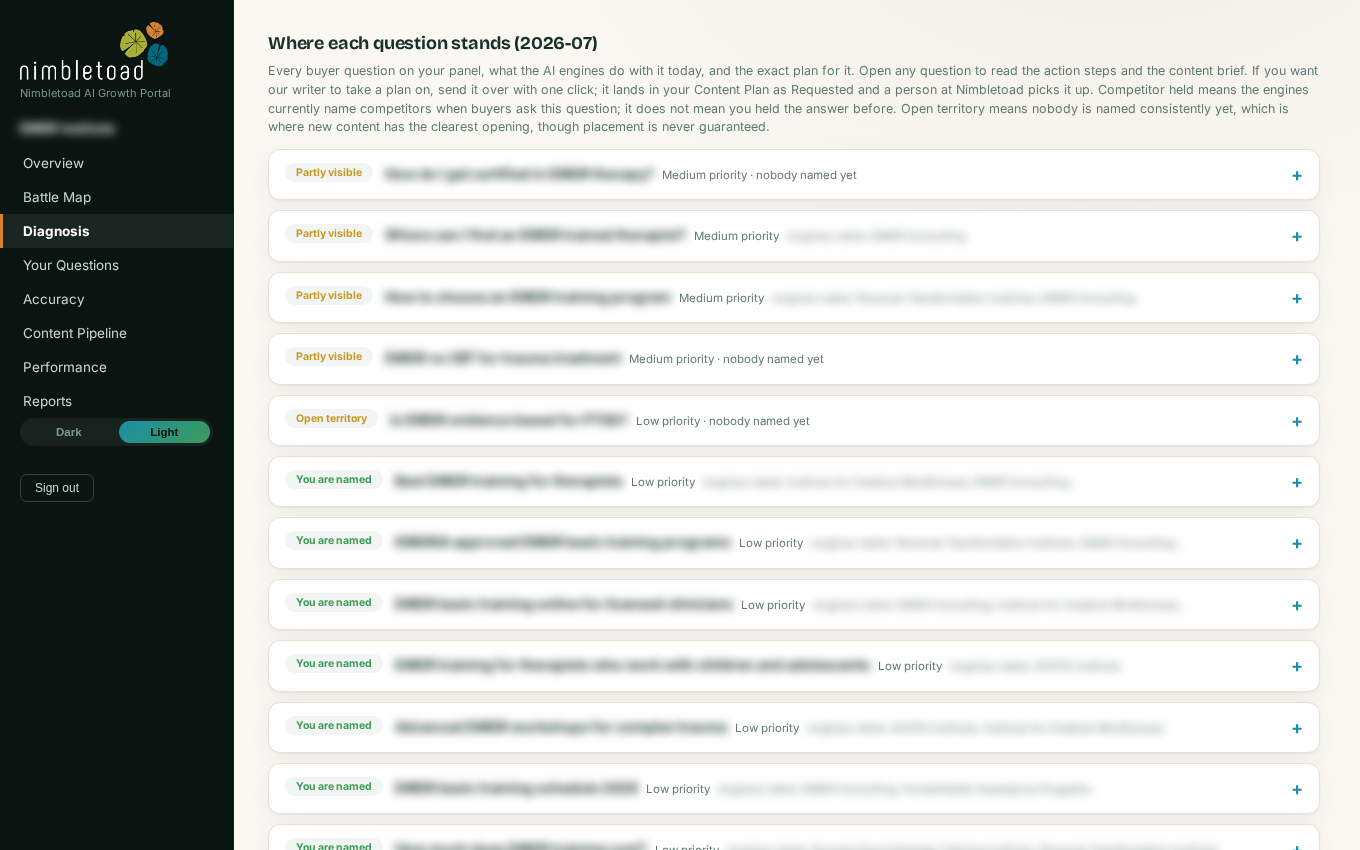
A real diagnosis view. Confidential details blurred, the format is exactly what you get.






In healthcare,
accuracy is the whole game
Health questions are the ones engines answer most confidently, and patients act on the answer. Getting your locations, your providers, and your services right in those answers is the difference between a booked appointment and a patient who never knew you existed.
One engine moved a real surgical practice to the wrong state and staffed it with surgeons who do not exist. A patient checking that answer against the practice website would reasonably conclude somebody is lying.
The questions AI answers
about practices like yours
Example question shapes, not client panels. Your panel is built from the way patients in your specialty and your region actually ask, and you see every question.
Measured monthly.
Watched weekly.
Measure
Your patient questions go to all eight engines every month, including Google AI Overviews and AI Mode. We score who gets named: you, or the practice the engine prefers today.
Diagnose
Every wrong claim about your practice gets a root cause and a fix plan aimed at the sources the engine actually cites.
Fix
Corrections and content grounded only in the verified practice facts in your Context Ledger, approved by you in a private portal before anything ships.
Prove
The next measurement confirms what the engines stopped claiming and where you became visible. Healthcare clients also get the weekly watchdog with same day alerts.
The full mechanism, including the battle map, receipts, and methodology, lives on the AI Visibility Engine page. Do the fixing yourself from our briefs, or have us write and ship it for you. We run your measurement before the demo, so the call opens on your own map.
See one full month, start to finish.
The questions we put to the engines, the answers they gave back word for word, a wrong claim traced to the page that caused it, and the next measurement checking whether it stopped. Real product screens, not a mockup.
Real product screens with confidential details blurred; the receipt scene uses a sample client.
Asked by practices like yours
Do patients really ask AI before choosing a provider?
Increasingly, yes. Health questions carry a privacy weight that makes AI chat attractive: patients ask an engine what they might hesitate to ask a friend or even a doctor. The engines answer with specific practice names, locations, and service descriptions. Whether those answers are accurate is exactly what we measure.
What kinds of wrong claims do engines make about healthcare practices?
Across the businesses we measure we have seen wrong locations, invented practitioners, confused specialties, and outdated service descriptions. One engine moved a California surgical practice to Colorado and named surgeons who do not exist. For healthcare these are not marketing problems. They erode patient trust before the first appointment.
How fast would we hear about a new wrong claim?
Healthcare clients sit in our weekly accuracy watchdog tier. Branded control checks run every week, not every month, and a new wrong claim raises a same day alert instead of waiting for the next monthly cycle.
How many times do you ask each question, and do you show when the answers disagreed?
Every engine gets every question multiple times each month, because AI answers are not stable the way a search result is. The same question an hour later can name a different set of businesses. Your battle map shows the count on any cell where the samples disagreed, so a result won three times out of three is never displayed as though it were the same as one won once. Across everything we measured last month, 8.6 percent of multi-sample cells came back differently from one ask to the next. We would rather show you that number than average it away.
Find out what AI tells your patients
The audit shows where your practice is invisible, who the engines recommend instead, and what they get factually wrong. Reviewed by a person before it reaches you.
Book a Demo