Be the organization AI names when donors ask.
AI answers route giving. Ask which organizations serve your community and the answer moves donation intent, volunteer hours, and grant attention. We measure what eight engines say about you and correct mission confusion at its sources.
API responses approximate but do not exactly match consumer app answers; we report these numbers as trend and share of voice comparisons, never as absolute truth.
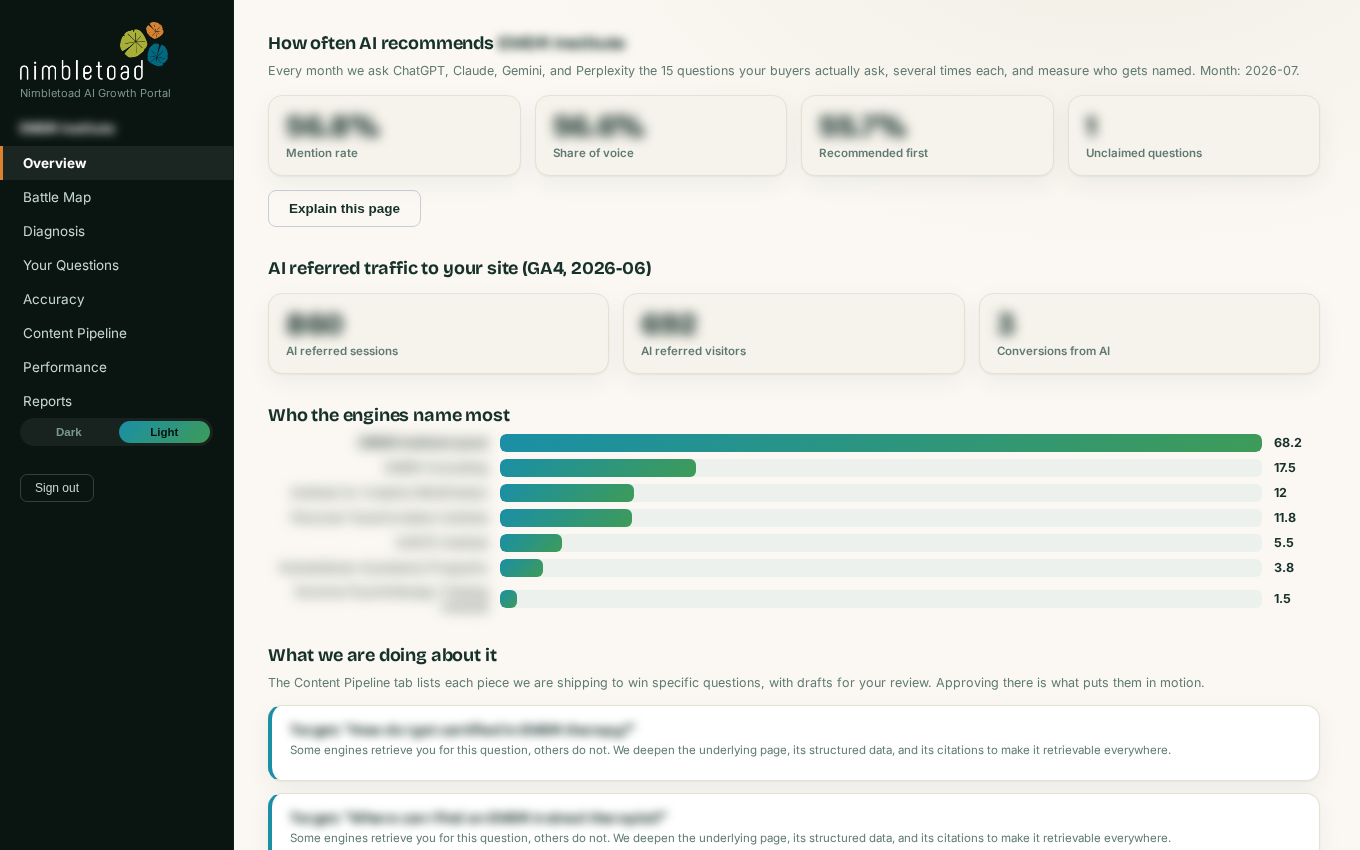
A real client portal. Confidential details blurred, the format is exactly what you get.






Described correctly,
and generosity follows
Donors give to organizations they can describe. When an engine has your mission, your region, and your name right, it does that describing for you, to people who have never heard of you yet.
Two community foundations we measure lead their markets with 72 percent and 54 percent AI share of voice. The engines are already routing generosity. The only question is whether your organization is on the map.
The questions AI answers
about organizations like yours
Example question shapes, not client panels. Your panel is built from the way donors, volunteers, and grantees in your community actually ask, and you see every question.
Measure. Diagnose. Fix. Prove.
Sized for mission budgets.
Measure
Your donor and volunteer questions go to all eight engines every month. We score who gets named: you, or the organization the engine prefers today.
Diagnose
Every mission mix-up and wrong claim gets a root cause and a fix plan aimed at the sources the engine actually cites.
Fix
Corrections and content grounded only in the verified organizational facts in your Context Ledger, approved by you in a private portal before anything ships.
Prove
The next measurement confirms what the engines stopped claiming and where you became visible, with your analytics next to the map.
The full mechanism, including the battle map, receipts, and methodology, lives on the AI Visibility Engine page. Do the fixing yourself from our briefs, or have us write and ship it for you. We run your measurement before the demo, so the call opens on your own map.
See one full month, start to finish.
The questions we put to the engines, the answers they gave back word for word, a wrong claim traced to the page that caused it, and the next measurement checking whether it stopped. Real product screens, not a mockup.
Real product screens with confidential details blurred; the receipt scene uses a sample client.
Asked by organizations like yours
Do donors actually ask AI where to give?
Yes. Donors ask which organizations serve a region, which charities are effective for a cause, and whether a specific organization is legitimate. The engines answer with names. In our measurements, two community foundations lead their markets with 72 percent and 54 percent AI share of voice, which means the engines are already steering donation intent somewhere.
What does AI get wrong about nonprofits?
Mission confusion is the big one. One engine described a childcare center as a hospital philanthropy program accepting donations. Engines also conflate similarly named organizations, mix up service regions, and describe programs that ended years ago. Donors checking those answers either give elsewhere or lose confidence entirely.
We are a small organization. Is this overkill?
The measurement is sized to the organization: a fixed panel of the 12 to 20 questions your donors and volunteers actually ask, run monthly. Small organizations are often the most exposed, because engines have thin information about them and fill the gaps with guesses. The audit is the cheap way to find out where you stand.
How many times do you ask each question, and do you show when the answers disagreed?
Every engine gets every question multiple times each month, because AI answers are not stable the way a search result is. The same question an hour later can name a different set of businesses. Your battle map shows the count on any cell where the samples disagreed, so a result won three times out of three is never displayed as though it were the same as one won once. Across everything we measured last month, 8.6 percent of multi-sample cells came back differently from one ask to the next. We would rather show you that number than average it away.
Find out what AI tells your donors
The audit shows where your organization is invisible, who the engines point donors to instead, and what they get factually wrong. Reviewed by a person before it reaches you.
Book a Demo