Be the training AI recommends.
AI is now the course catalog. Professionals ask for the best training in a field and get a short list. We measure whether you are on it, across eight engines every month, and go to work where a competitor holds the answer.
API responses approximate but do not exactly match consumer app answers; we report these numbers as trend and share of voice comparisons, never as absolute truth.
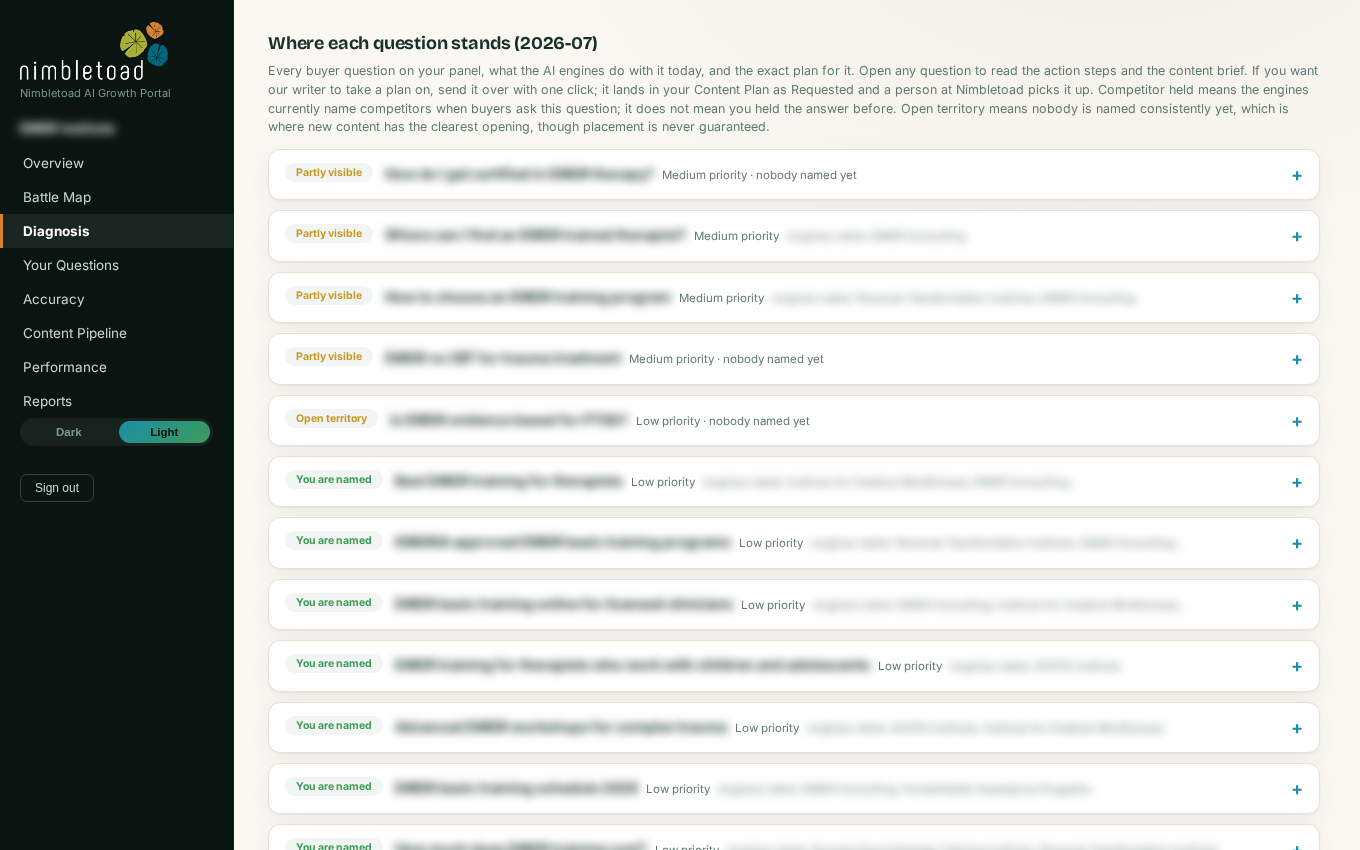
A real diagnosis view. Confidential details blurred, the format is exactly what you get.






The institute the engine names
gets the registration
Professionals compare programs, verify approval status, and check schedules before committing tuition and CE time. Engines now run that comparison for them, and the institute the engine recommends gets the registration.
One training institute we measure earned 860 AI referred sessions and 3 tracked conversions in a single month. Measured in analytics, reported as a trend, never inflated. AI is already sending registrants somewhere.
The questions AI answers
about programs like yours
Example question shapes, not client panels. Your panel is built from the way professionals in your field actually ask, and you see every question.
Measure. Diagnose. Fix. Prove.
Every month, on schedule.
Measure
Your registrant questions go to all eight engines every month. We score who gets named and who gets recommended: you, or the program the engine prefers today.
Diagnose
Every wrong claim about schedules, credits, or curriculum gets a root cause and a fix plan aimed at the sources the engine actually cites.
Fix
Corrections and content grounded only in the verified program facts in your Context Ledger, approved by you in a private portal before anything ships.
Prove
The next measurement confirms what the engines stopped claiming and where you became visible, with AI referred sessions from your analytics next to the map.
The full mechanism, including the battle map, receipts, and methodology, lives on the AI Visibility Engine page. Do the fixing yourself from our briefs, or have us write and ship it for you. We run your measurement before the demo, so the call opens on your own map.
See one full month, start to finish.
The questions we put to the engines, the answers they gave back word for word, a wrong claim traced to the page that caused it, and the next measurement checking whether it stopped. Real product screens, not a mockup.
Real product screens with confidential details blurred; the receipt scene uses a sample client.
Asked by programs like yours
Do professionals really pick trainings through AI?
Increasingly, yes. A clinician asking "best certification in my modality" or "CE workshops this year" gets a short list, and the engines compose that list from whatever sources they trust. One training institute we measure earned 860 AI referred website sessions in a single month, with tracked conversions in analytics. AI is already a registration channel.
Our institute basically invented our field. Does AI know that?
Often the engines know the field better than they know you. They answer questions about the modality in general, cite newer competitors, and hand your history to whoever published the better page. We measure recommendation separately from mention, so being the origin of a field never gets confused with being recommended for training in it.
What do engines get wrong about training programs?
Certification requirements, schedules, prices, and approval status. Engines invent cohort dates, misstate CE credit eligibility, and attribute your curriculum to competitors. Every wrong claim we find gets a fix plan aimed at the sources the engine cited, and the next measurement confirms whether the claim stopped.
How many times do you ask each question, and do you show when the answers disagreed?
Every engine gets every question multiple times each month, because AI answers are not stable the way a search result is. The same question an hour later can name a different set of businesses. Your battle map shows the count on any cell where the samples disagreed, so a result won three times out of three is never displayed as though it were the same as one won once. Across everything we measured last month, 8.6 percent of multi-sample cells came back differently from one ask to the next. We would rather show you that number than average it away.
Find out what AI tells your registrants
The audit shows where your program is invisible, which competitors the engines recommend instead, and what they get factually wrong. Reviewed by a person before it reaches you.
Book a Demo