Be the name AI gives your next client.
AI recommends people, by name. Therapists, doctors, lawyers, advisors: we measure which names come back in your market every month, show you the ranked list, and build your name into the answers.
API responses approximate but do not exactly match consumer app answers; we report these numbers as trend and share of voice comparisons, never as absolute truth.
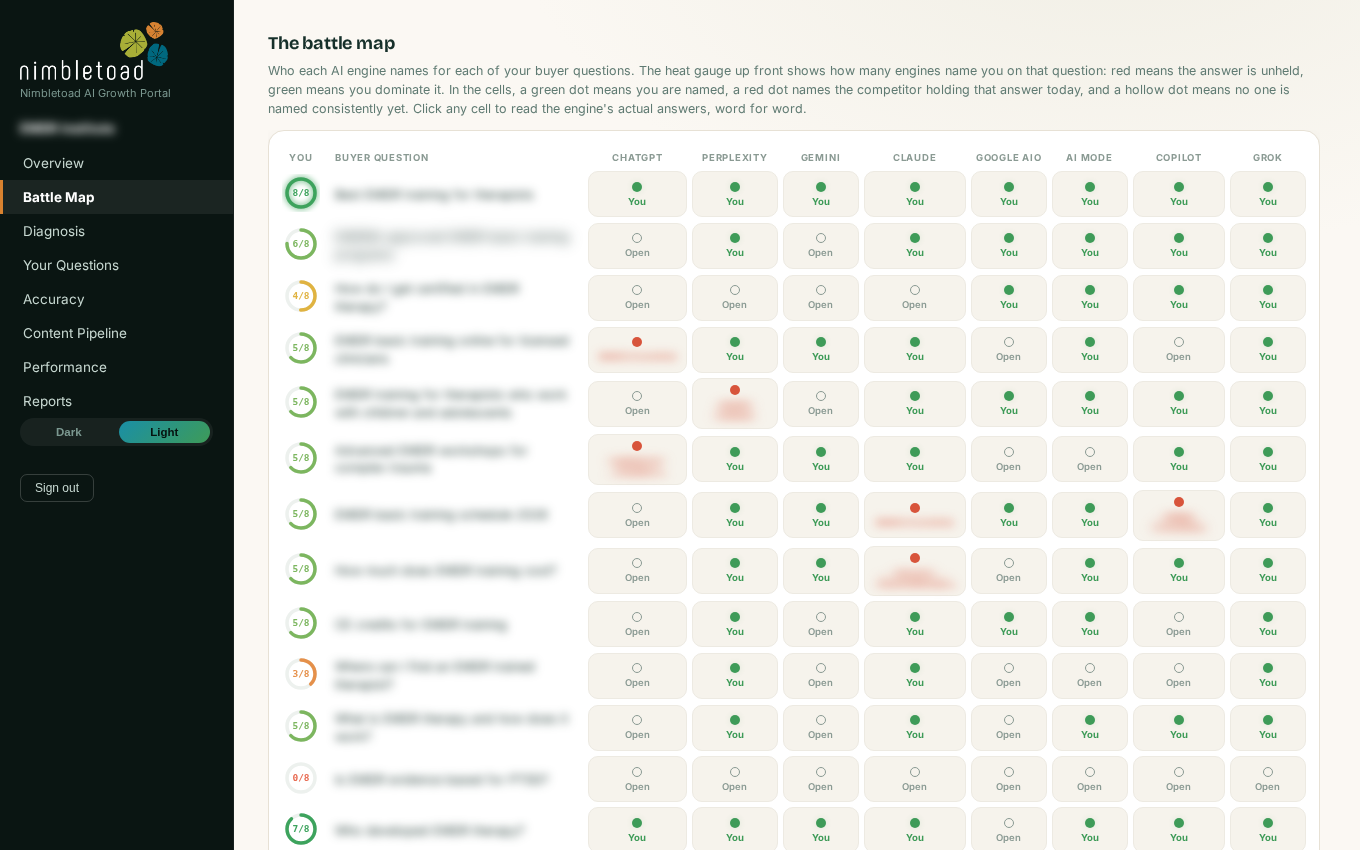
A real battle map. Confidential details blurred, the format is exactly what you get.






The engines recommend people.
Yours can be one of them.
A client who asks an engine for a therapist, a surgeon, or an attorney gets two or three names and contacts one. In one market we measured, engines named rival practitioners dozens of times each across 402 answers. The engines answer with people, and a name is something you can build.
The audit for a practitioner leads with one page: the ranked list of every named person AI recommends instead of you, how often, and on which questions. It is the clearest picture of your market you will see this year.
The questions AI answers
about practitioners like you
Example question shapes, not client panels. Your panel is built from the way clients in your field and your market actually ask, and you see every question.
Measure. Diagnose. Fix. Prove.
Every month, on schedule.
Measure
Your market's client questions go to all eight engines every month. We score who gets named: you, or the practitioners the engines prefer today, including new names our person watch catches entering the answers.
Diagnose
Every lost question gets a root cause: who holds the answer, which sources the engine cited, and what those sources say that yours do not. Wrong claims about you are documented in the engine's own words.
Fix
We build you as the entity the engines can retrieve: claimed and consistent profiles on the sources they actually cite, Person and professional structured data, and answer pages grounded only in your verified facts, approved by you before anything ships.
Prove
The next measurement confirms where your name entered the answers and what the engines stopped getting wrong, with the visits AI assistants sent from your own analytics beside the map.
The full mechanism, including the battle map, receipts, and methodology, lives on the AI Visibility Engine page. Do the fixing yourself from our briefs, or have us write and ship it for you. We run your measurement before the demo, so the call opens on your own map. Selling homes instead of sessions? The real estate agent page shows the same measurement in the market where we proved it.
See one full month, start to finish.
The questions we put to the engines, the answers they gave back word for word, a wrong claim traced to the page that caused it, and the next measurement checking whether it stopped. Real product screens, not a mockup.
Real product screens with confidential details blurred; the receipt scene uses a sample client.
Asked by people whose name is the practice
Do clients really ask AI for a specific person?
Yes. In person driven fields the engines answer recommendation questions with named individuals, not just firm names. We proved the pattern in a real estate market first: the engines named individual agents dozens of times each in one month while the client we measured appeared in zero of 402 answers. The same person first dynamic holds wherever the practitioner is the brand: therapy, medicine, law, financial advice.
My practice has a website. Is that not enough?
The engines lean heavily on the sources they already trust: professional directories, review profiles, and reference pages. When we trace where answers come from, those citations are profile level, about the person. A practice site matters, but a thin or unclaimed directory presence can keep you out of the answers no matter how good the site is. We measure which sources the engines cite in your field and market, then build your presence on exactly those.
What if AI says something wrong about me?
Wrong claims about individuals are common and costly: confused specialties, invented locations, and mix ups with a different person who shares your name. Every wrong claim we find gets documented in the engine’s own words, a correction plan aimed at the cited sources, and a next measurement that shows whether the engine stopped. For licensed professions an AI answer that misstates what you do is not just lost business, it is a reputation problem, so our healthcare tier clients get weekly accuracy checks.
How many times do you ask each question, and do you show when the answers disagreed?
Every engine gets every question multiple times each month, because AI answers are not stable the way a search result is. The same question an hour later can name a different set of businesses. Your battle map shows the count on any cell where the samples disagreed, so a result won three times out of three is never displayed as though it were the same as one won once. Across everything we measured last month, 8.6 percent of multi-sample cells came back differently from one ask to the next. We would rather show you that number than average it away.
Find out which names AI recommends in your field
The audit shows the named people the engines put in front of your clients, where you are invisible, and what AI gets factually wrong about you. Reviewed by a person before it reaches you.
Book a Demo